World Ozone Day 2025: Ozone Layer Recovery Shows Global Action Works When Science Leads
World ozone day 2025 : layer recovery progress (Image source:X)
September 16, 2025 – As the world observes World Ozone Day today, marking the 40th anniversary of the Vienna Convention, new scientific data confirms the ozone layer’s continued recovery, demonstrating the power of science-driven international cooperation.
Ozone Layer Healing According to Latest WMO Data
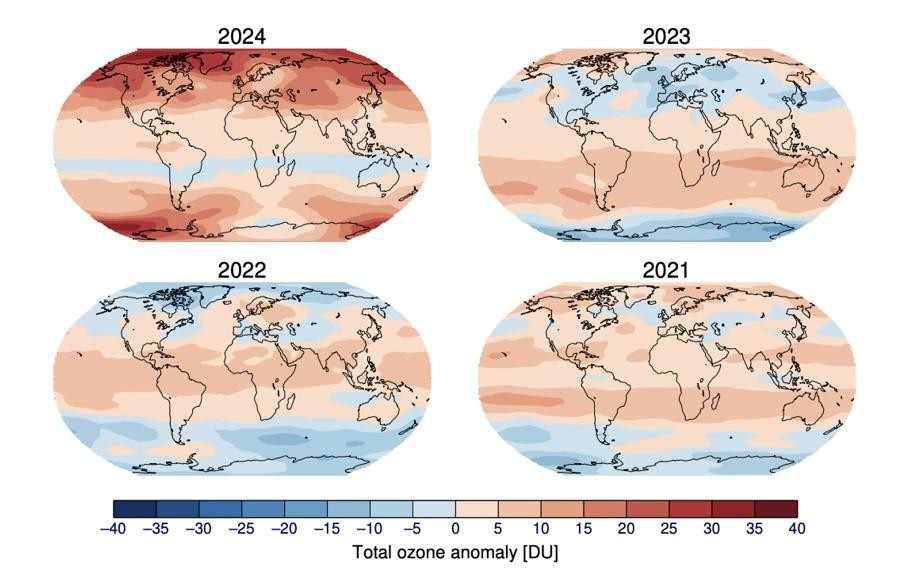
The Earth’s protective ozone layer is healing and the ozone hole in 2024 was smaller than in recent years, according to a new World Meteorological Organization (WMO) report which contains welcome scientific news for people’s and planetary health.
The WMO Ozone Bulletin reported that the low level of ozone depletion observed in 2024 was partly due to naturally occurring atmospheric factors which drive year-to-year fluctuations. However, the long-term positive trend reflects the success of concerted international action.
The 2024 Antarctic ozone hole showed particularly encouraging signs. The depth of 2024 Antarctic ozone hole – which appears over the Antarctic every spring – was below the 1990–2020 average, with a maximum ozone mass deficit (OMD) of 46.1 million tonnes on 29 September. It was smaller than the relatively large holes between 2020 and 2023.
Montreal Protocol: The World’s Most Successful Environmental Treaty
The international treaty called The Montreal Protocol on Substances that Deplete the Ozone Layer is gradually eliminating the production and consumption of ozone depleting substances to limit their damage to the earth’s ozone layer. The Montreal Protocol is signed by 197 countries – the first treaty in the history of the United Nations to achieve universal ratification – and is considered by many the most successful environmental global action.
The protocol’s remarkable success is measurable in concrete terms. To date, the Montreal Protocol has led to the phase-out of over 99% of the production and consumption of controlled ozone-depleting substances, which were used in refrigeration, air conditioning, firefighting foam and even hairspray.
Recovery Timeline: When Will the Ozone Layer Fully Heal?
Scientists have established clear timelines for ozone layer recovery across different regions. If current policies remain in place, the ozone layer is expected to recover to 1980 values (before the appearance of the ozone hole) by around 2066 over the Antarctic, by 2045 over the Arctic and by 2040 for the rest of the world, according to the most recent assessment in 2022.
As a result, the ozone layer is now on track to recover to 1980s levels by the middle of this century, significantly reducing risks of skin cancer, cataracts, and ecosystem damage due to excessive UV exposure.
From Vienna Convention to Global Success
The journey began 40 years ago with the Vienna Convention, which laid the groundwork for unprecedented international cooperation. The Vienna Convention and its Montreal Protocol became a landmark of multilateral success. Today, the ozone layer is healing. This achievement reminds us that when nations heed the warnings of science, progress is possible, said United Nations Secretary-General António Guterres.
The Kigali Amendment: Addressing Climate Change Too
The Montreal Protocol’s evolution demonstrates adaptive global governance. The most recent amendment, the Kigali Amendment, called for the phase-down of hydrofluorocarbons (HFCs) in 2016. These HFCs were used as replacements for a batch of ozone-depleting substances eliminated by the original Montreal Protocol. Although they do not deplete the ozone layer, they are known to be powerful greenhouse gases and, thus, contributors to climate change.
With the Amendment ratified by 164 parties to date, the phase-down is progressing according to the agreed schedules and is expected to avoid up to 0.5 °C of global warming by the end of the century.
Science-Based Action as a Model for Global Challenges
The United States signed the Montreal Protocol in 1987, and has been a leader in guiding the successes of the treaty. Over the past 30 years, EPA has been a proud contributor to the broad coalition that developed and implemented flexible, innovative, and effective approaches to protect the stratospheric ozone layer.
WMO Secretary-General Celeste Saulo emphasized the importance of scientific foundation: “The theme for World Ozone Day is From Science to Global Action. It mirrors WMO’s 75th anniversary slogan Science for Action. This is no coincidence. WMO’s scientific research into the ozone layer dates back decades. It is underpinned by trust, international collaboration and commitment to free data exchange – all cornerstones of the world’s most successful environmental agreement.”
Monitoring Remains Critical for Continued Success
Despite the remarkable progress, scientists stress the importance of continued vigilance. “Despite the great success of the Montreal Protocol in the intervening decades, this work is not yet finished, and there remains an essential need for the world to continue careful systematic monitoring of both stratospheric ozone and of ozone-depleting substances and their replacements,” said Matt Tully, Chair of WMO’s Scientific Advisory Group on Ozone and Solar UV Radiation.
Supporting Global Development Goals
The ozone layer’s recovery has far-reaching benefits beyond environmental protection. Protecting the ozone layer and thereby human, environmental and agricultural health has enabled significant progress towards achieving many of the United Nations Sustainable Development Goals, including SDG 3 (Good Health and Well-Being), SDG 13 (Climate Action), SDG 2 (Zero Hunger) and SDG 15 (Life on Land).
A Blueprint for Future Environmental Action
As the world faces new climate challenges, the Montreal Protocol offers both inspiration and practical lessons. The Montreal Protocol provided a set of practical, actionable tasks that were universally agreed on. The Protocol has successfully met its objectives thus far and continues to safeguard the ozone layer today. Thanks to the collaborative effort of nations around the world, the ozone layer is well on its way to recovery.
In 1995, the United Nations named September 16 the International Day for the Protection of the Ozone Layer, also known as World Ozone Day. This annual observance serves as both celebration of environmental success and reminder that science-based international cooperation can solve even the most daunting global challenges.
The healing ozone layer stands as proof that when humanity unites behind scientific evidence and takes decisive collective action, environmental recovery is not just possible—it’s achievable within decades.
Also Read: The Triumph of Perseverance: Albert Szent-Györgyi’s Journey from War to Nobel Prize

Ambika Krishnamurthy is an education news writer dedicated to covering academic updates, exam alerts, policy changes, and student-centric stories. With a focus on clarity and reliability, she aims to keep readers informed about the latest developments in the education sector, helping students and educators stay ahead in their academic journeys.