


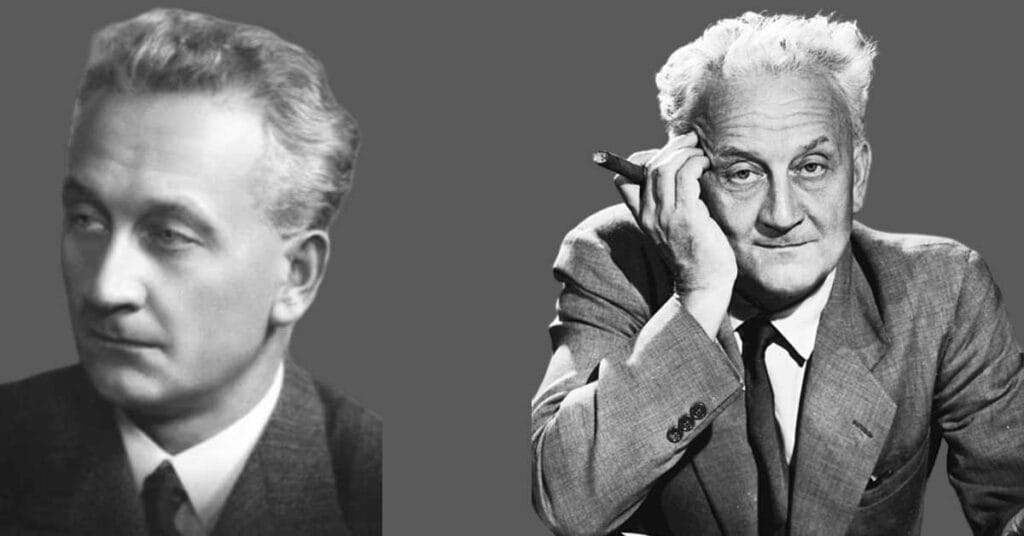
Albert Szent-GyörgyiCelebrating the birthday of a scientist who turned adversity into groundbreaking discoveries
On September 16, 1893, the world welcomed a future Nobel laureate who would revolutionize our understanding of nutrition and cellular biology. Albert von Szent-Györgyi was born into an intellectually privileged family in Budapest, yet his path to scientific greatness was far from smooth. His story is one of remarkable resilience, where personal struggles, world wars, and political upheaval became the crucible that forged one of the 20th century’s most influential biochemists.
Early Promise Interrupted by War
Szent-Györgyi‘s scientific journey began promisingly in his uncle’s laboratory at the University of Budapest, where he matriculated in 1911. However, the outbreak of World War I in 1914 abruptly interrupted his studies when he was mobilized for military service. Rather than viewing this as a setback, Szent-Györgyi served with distinction on both the Italian and Russian fronts, earning the Silver Medal for Valour. His military service ended in 1917 when he was wounded in action, but this experience would prove formative in shaping his character of determination under pressure.
The war taught Szent-Györgyi valuable lessons about perseverance and adaptability that would serve him throughout his scientific career. Upon his discharge, he immediately resumed his studies, completing his education in Budapest despite the chaos of post-war Hungary. This early demonstration of resilience—the ability to bounce back from disruption and maintain focus on his goals—became a defining characteristic of his approach to both life and science.
The Wandering Scholar: Building Excellence Through Diversity
Following his graduation, Szent-Györgyi embarked on what could be called an academic odyssey across Europe and America. Rather than settling into a comfortable position, he deliberately sought diverse experiences and mentorship from leading scientists of his time. He worked successively with pharmacologist G. Mansfeld at Pozsony, studied electrophysiology with Armin von Tschermak at Prague, collaborated with L. Michaelis in Berlin, and pursued physical chemistry at the Institute for Tropical Hygiene in Hamburg.
This nomadic period from 1920 to 1930 was challenging both personally and professionally. Moving frequently meant constantly adapting to new environments, languages, and scientific cultures. Financial uncertainty was a constant companion, and establishing himself in each new location required tremendous personal resilience. However, this diversity of experience proved invaluable, giving Szent-Györgyi a uniquely broad perspective on biochemistry that would later enable his groundbreaking integrative discoveries.
His time in the Netherlands, working first as an assistant at the University Institute of Pharmacology in Leiden (1920) and then with H.J. Hamburger at the Physiology Institute in Groningen (1922-1926), was particularly formative. It was here that he began his pioneering research on cell respiration, describing the interdependence of oxygen and hydrogen activation. These early investigations laid the groundwork for his later Nobel Prize-winning discoveries.
The Cambridge Breakthrough: Isolation of Vitamin C
Szent-Györgyi‘s persistence in seeking excellence led him to Cambridge University in 1927 as a Rockefeller Fellow, working under the renowned F.G. Hopkins. This appointment represented both an opportunity and a challenge. While Cambridge provided access to world-class facilities and collaborators, Szent-Györgyi faced the pressure of justifying his fellowship and making significant contributions in a highly competitive environment.
It was during his time at Cambridge and a subsequent year at the Mayo Foundation in Rochester, Minnesota, that Szent-Györgyi made his most famous discovery. He isolated a reducing substance from adrenal glands and plant tissues, initially calling it “hexuronic acid.” This substance would later be identified as ascorbic acid—vitamin C. The discovery wasn’t immediate or easy; it required painstaking chemical analysis and innovative experimental approaches.
What made this discovery particularly significant was Szent-Györgyi‘s ability to recognize the broader implications of his findings. Upon returning to Hungary in 1930 to take the Chair of Medical Chemistry at the University of Szeged, he noted the anti-scorbutic (scurvy-preventing) activity of ascorbic acid. His keen observation that paprika (Capsicum annuum) was a rich source of vitamin C not only provided a practical solution for vitamin C deficiency but also demonstrated his ability to connect basic research with real-world applications.
Scientific Innovation Under Political Pressure
The 1930s brought new challenges as fascism rose across Europe. Szent-Györgyi found himself in the difficult position of pursuing scientific excellence while living under an increasingly oppressive political regime. His moral courage became evident as he took an actively anti-Nazi stance, helping Jewish friends flee Hungary and participating in resistance activities.
The personal risks were enormous. Adolf Hitler allegedly ordered Szent-Györgyi‘s arrest personally, and for part of World War II, he was forced into hiding from the Gestapo. During this period, the Swedish Embassy in Budapest provided crucial protection, eventually helping him secure Swedish citizenship. Despite these life-threatening circumstances, Szent-Györgyi continued his research, making groundbreaking discoveries about muscle contraction.
In 1938, while political tensions escalated, Szent-Györgyi commenced his revolutionary work on muscle research. He discovered the proteins actin and myosin and their complex, leading to a reproduction of the fundamental reaction of muscle contraction. This work, conducted under the shadow of war and personal danger, formed the foundation of muscle research for decades to come.
Lessons from a Master of Resilience
Szent-Györgyi‘s life offers profound lessons for anyone facing obstacles in pursuit of their goals:
Embrace Adversity as Education : Rather than being derailed by World War I, Szent-Györgyi used his military experience to develop resilience and discipline that served his scientific career. He understood that challenges often provide the most valuable learning experiences.
Diversity Breeds Innovation : His willingness to work in multiple countries and disciplines gave him a unique perspective that enabled breakthrough discoveries. Szent-Györgyi demonstrated that comfort zones are the enemy of excellence.
Moral Courage Enhances Scientific Integrity : His anti-Nazi stance and assistance to Jewish refugees during World War II showed that scientific excellence and moral courage are not separate virtues but complementary aspects of a life well-lived.
Persistence in the Face of Uncertainty : The discovery of vitamin C required years of patient work with uncertain outcomes. Szent-Györgyi‘s persistence through periods of doubt and limited resources exemplifies the dedication required for significant scientific breakthroughs.
Integration Over Specialization : Rather than focusing narrowly on one area, Szent-Györgyi‘s broad interests—from cell respiration to muscle contraction—allowed him to make connections that specialists might miss.
Legacy and Recognition
Szent-Györgyi‘s contributions were recognized with the Nobel prize in Physiology or Medicine in 1937, awarded for his discoveries related to biological oxidation processes and vitamin C. He later received the Lasker Award in 1954 and membership in the U.S. National Academy of Sciences in 1956. However, his true legacy lies not just in his scientific discoveries but in his demonstration that excellence emerges from the marriage of rigorous scientific method with moral courage and personal resilience.
After immigrating to the United States in 1947, Szent-Györgyi continued his research at Woods Hole, Massachusetts, where he directed the Institute of Muscle Research. Even in his later years, he remained committed to pushing scientific boundaries, investigating everything from cancer research to the theoretical foundations of life itself.
In his later career, Szent-Györgyi co-founded the National Foundation for Cancer Research and pioneered groundbreaking research into the connections between free radicals and cancer (NFCR) . He theorized that disruption of electron-transfer systems by free radicals could push cells into uncontrolled proliferative states characteristic of cancer. His visionary work in submolecular biology and quantum physics applications to biological processes opened new research perspectives on cancer mechanisms. The prestigious Szent-Györgyi Prize for Progress in Cancer Research honors his legacy.
Conclusion: The Szent-Györgyi Formula for Success
As we celebrate Albert Szent-Györgyi‘s birthday, we honor not just a brilliant scientist but a model of human resilience. His life demonstrates that greatness isn’t achieved despite obstacles but often because of them. The wars, displacements, political pressures, and scientific uncertainties he faced were not impediments to his success—they were the circumstances that revealed and developed his extraordinary capabilities.
Szent-Györgyi‘s story teaches us that the path to significant achievement requires more than talent or opportunity. It demands the courage to embrace challenges, the wisdom to learn from diverse experiences, the persistence to pursue long-term goals despite short-term setbacks, and the moral strength to maintain one’s principles under pressure.
In our own pursuits, whether scientific, professional, or personal, we can draw inspiration from Szent-Györgyi’s example. His life reminds us that the greatest discoveries—whether in science or in ourselves—often emerge not from comfort and certainty but from our willingness to venture into the unknown, persist through difficulties, and maintain our integrity regardless of external pressures.
The biochemist who started his career interrupted by war and ended it as one of the most celebrated scientists of his generation proves that with sufficient determination, moral courage, and intellectual curiosity, any obstacle can become a stepping stone to greatness.
Also Read: Indian-Origin Teen Tejasvi Manoj Honored as TIME’s Kid of the Year at 17


Ambika Krishnamurthy is an education news writer dedicated to covering academic updates, exam alerts, policy changes, and student-centric stories. With a focus on clarity and reliability, she aims to keep readers informed about the latest developments in the education sector, helping students and educators stay ahead in their academic journeys.