


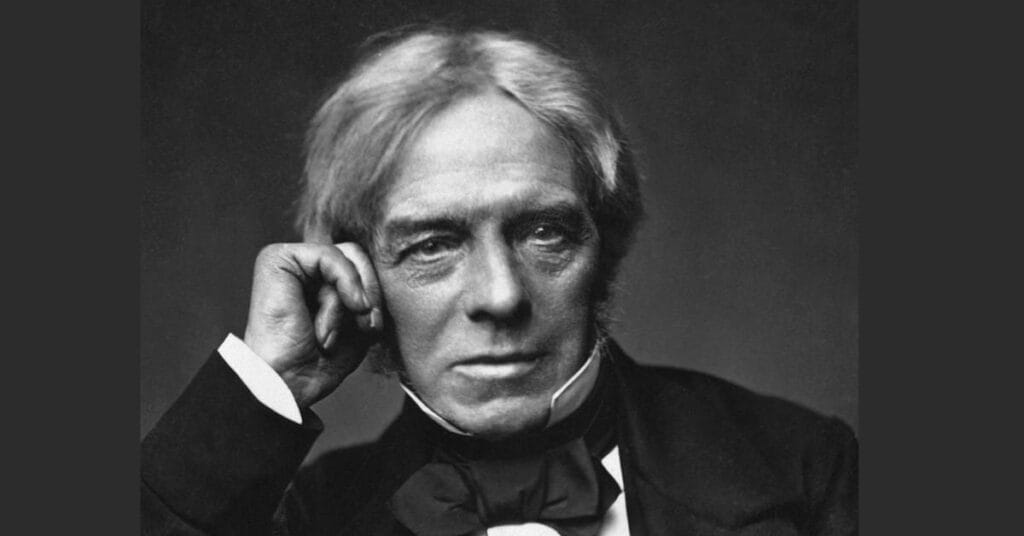
Michael Faraday’s life is one of the most inspiring stories in the history of science. Born into poverty, with almost no formal schooling, he went on to become one of the giants of physics and chemistry, transforming our understanding of electricity, magnetism, and chemistry. His journey from humble beginnings to becoming a scientific superstar still resonates today.
Early Life: Humble Origins & Minimal Schooling
Michael Faraday was born on 22 September 1791 in Newington, Surrey (now part of South London). His family was poor — his father was a blacksmith who had recently moved from northern England, often unwell, and his mother supported the family by managing their home and children. Faraday was one of four siblings.
Faraday’s formal education was extremely limited. He received only the basics: reading, writing, and arithmetic (“ciphering”) at a Sunday school. By age 14, he was apprenticed to a bookbinder (George Riebau), which was a common trade for boys of his socio-economic class. This apprenticeship would prove pivotal, because through the books he bound, he gained exposure to scientific ideas far beyond his formal schooling.
Self-Education: The Spark & the Lectures
Working as a bookbinder’s apprentice gave Faraday access to the books coming through for binding. He read widely, including scientific texts such as the Electricity article in the Encyclopædia Britannica and Jane Marcet’s Conversations on Chemistry. These readings fed his curiosity and set the stage for his first experiments in electricity and electrochemistry.
An important turning point came when Faraday, at the age of 20 or so, obtained tickets to attend Sir Humphry Davy’s lectures on chemistry at the Royal Institution. He took careful notes, bound them, and later sent a copy with a letter of application to Davy. At first, there was no job, but when one of Davy’s assistants left, Faraday was remembered and offered a position as Davy’s assistant.
Rise to Prominence: Discoveries and Contributions
Once working under Humphry Davy, Faraday developed both his experimental skills and scientific insight. He started as a chemist: investigating new organic compounds, isolating benzene in 1825, improving optical glass, and exploring the effects of chlorine.
But Faraday’s most enduring contributions came in electricity and magnetism:
In 1821, he demonstrated the first electric motor, showing that electrical current can produce motion when in proximity with magnetic forces.
In 1831, he discovered electromagnetic induction — that changing magnetic fields produce electric currents. This is foundational to how generators and transformers work.
He formulated the two laws of electrolysis, which quantify how electric charge relates to chemical changes in a solution.
He discovered diamagnetism and showed how magnetic fields can affect light (now known as the Faraday effect).
Faraday did all this with very limited mathematics. He was more of an intuitive experimentalist than a theoretical one: his strength was in designing experiments and observing what nature does, rather than in complex mathematical proofs.
Integrity, Character & Influence
Aside from his scientific achievements, Faraday was known for his humility, dedication, and character. He came from a religious background (Sandemanians) which influenced his worldview: seeing the study of nature as a way to understand God’s laws.
He taught widely (he was professor at the Royal Institution) and gave the Christmas Lectures, aimed at young people and lay audiences, helping spread scientific knowledge.
Faraday also declined many honors later in life — he was not motivated by fame or recognition, but by discovery and understanding.
Legacy: From Little Education to Immortal Science
Michael Faraday died on 25 August 1867, at Hampton Court, Surrey, leaving behind a legacy that shapes modern science and technology.
His discoveries are at the heart of much of the electrical world: the electric motor, generator, transformer, electrochemical processes, and our understanding of light, magnetism, and fields. The very basis of Maxwell’s equations — and later, modern physics — rests heavily on Faraday’s experimental findings.
Takeaways: What We Learn from Faraday’s Life
Curiosity and self-study matter: Even without formal schooling, Faraday’s eager reading and experimenting changed the world.
Opportunities matter: The chance to attend lectures by Davy, and inject himself into the scientific community, was a breakthrough.
Experimentation & observation can lead to theory: Faraday built his understanding from what he saw, tested, and refined.
Character counts: Honesty, clarity of thought, humility — Faraday shows these help even in the highest realms of science.
Conclusion
Michael Faraday is living proof that formal education, while valuable, is not the only path to scientific greatness. He rose from the son of a blacksmith, with only rudimentary schooling, to become one of the most important scientists of the 19th century — a man whose experiments paved the way for everything from electric motors to modern physics. For anyone doubting their path because they lack traditional credentials, Faraday’s life is a reminder that passion, perseverance, and hands-on learning can carry you extraordinarily far.
Also Read: The Triumph of Perseverance: Albert Szent-Györgyi’s Journey from War to Nobel Prize


Ambika Krishnamurthy is an education news writer dedicated to covering academic updates, exam alerts, policy changes, and student-centric stories. With a focus on clarity and reliability, she aims to keep readers informed about the latest developments in the education sector, helping students and educators stay ahead in their academic journeys.