


In a groundbreaking reform that positions India at the forefront of global education innovation, the Ministry of Education has officially announced that AI Integration in School Curriculum will become mandatory for all students starting from Class 3 in the 2026-27 academic year. This historic decision marks one of the earliest efforts worldwide to introduce Artificial Intelligence education at the foundational level.
The Department of School Education and Literacy (DoSE&L) confirmed that Artificial Intelligence and Computational Thinking will be treated as universal skills, integrated seamlessly into the national curriculum framework. “We must act swiftly to ensure both students and teachers are ready to embrace this transformative technology,” stated School Education Secretary Sanjay Kumar during the official announcement.
Expert Committee Led by IIT Madras Professor
To ensure world-class curriculum development, the Central Board of Secondary Education (CBSE) has constituted an expert committee chaired by Professor Karthik Raman of IIT Madras. The committee is working in close collaboration with NCERT, Kendriya Vidyalaya Sangathan (KVS), Navodaya Vidyalaya Samiti (NVS), and state education departments to design age-appropriate learning modules.
The AI Integration in School Curriculum initiative aligns with the National Education Policy (NEP) 2020 and the National Curriculum Framework for School Education (NCF-SE) 2023, ensuring that India’s education system remains future-ready and globally competitive.

December 2025 Deadline for Complete Resource Materials
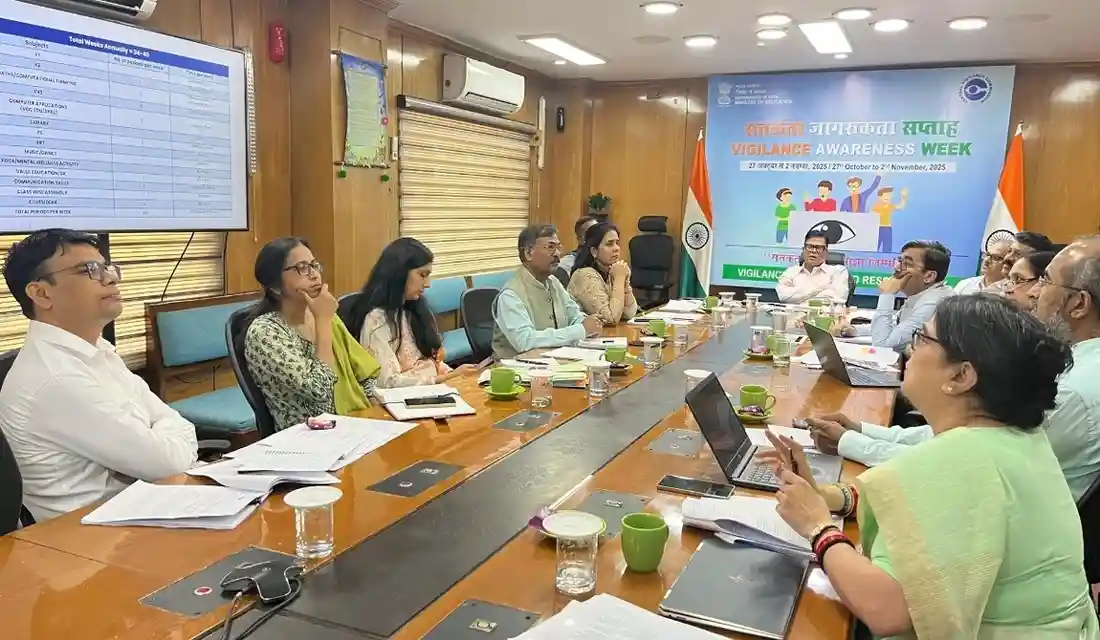
According to the Ministry’s roadmap finalized during a stakeholder consultation held on October 29, 2025, comprehensive textbooks, teacher handbooks, video-based learning resources, and digital content will be ready by December 2025. This accelerated timeline demonstrates the government’s commitment to rapid implementation.
The real challenge, as highlighted by Secretary Sanjay Kumar, lies in preparing over one crore teachers across India to confidently teach AI concepts. To address this, extensive teacher training programs will be conducted through NISHTHA (National Initiative for School Heads and Teachers Holistic Advancement) and other national platforms supported by NCERT.
Beyond Coding: Ethics and Public Good
What sets this AI Integration in School Curriculum apart from mere technical training is its emphasis on ethical AI use and social responsibility. The curriculum will focus on “AI for Public Good,” teaching students not just how AI works, but how technology can be used responsibly to solve real-world challenges.
Officials emphasized that the program will promote critical thinking, creativity, and problem-solving capabilities alongside technical skills. The curriculum will be linked to the theme “The World Around Us,” making AI education contextual and relatable for young learners.
India Leads Global AI Education Movement
This initiative places India among the front-runners in integrating AI education at the school level, potentially creating a generation of technologically empowered, analytically strong, and socially conscious citizens. With over 18,000 CBSE schools already offering AI as a skill subject for higher classes, the expansion to Class 3 represents a natural progression in India’s digital education journey.
A coordination committee between NCERT and CBSE will oversee quality assurance and structured implementation across diverse educational systems nationwide, ensuring that AI Integration in School Curriculum reaches every corner of the country, from urban centers to rural areas.
As India prepares to launch this transformative reform, the Ministry’s vision is clear: equip every child with the foundational AI skills needed to thrive in an increasingly digital economy while maintaining strong ethical values and social consciousness.
Don’t miss the most important news & updates of the day. Get them on our


Ambika Krishnamurthy is an education news writer dedicated to covering academic updates, exam alerts, policy changes, and student-centric stories. With a focus on clarity and reliability, she aims to keep readers informed about the latest developments in the education sector, helping students and educators stay ahead in their academic journeys.